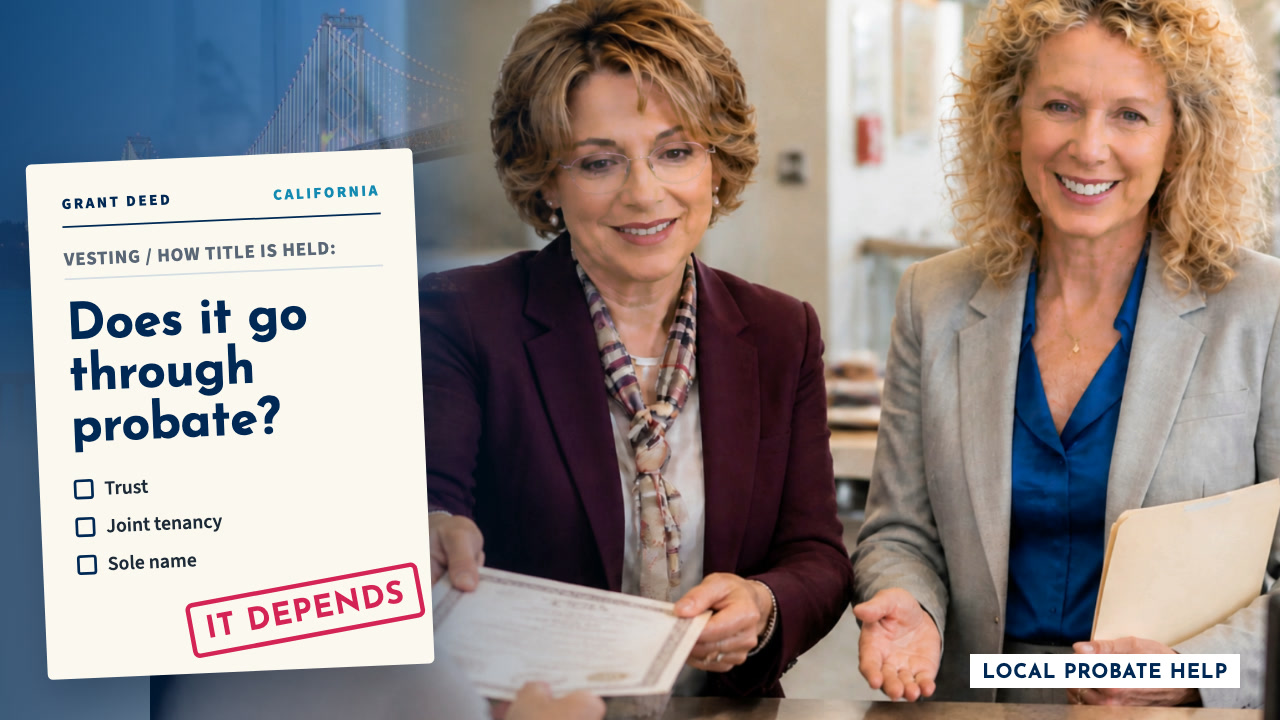
Does a Property Have to Go Through Probate in California? It Depends on How It's Titled
After someone passes away, one of the first questions is what happens to the property.
Many people assume every property goes through probate. Others assume none does. In California, the answer usually starts with one document: the deed.
How the property is titled, often called its vesting, can decide whether the property passes without probate, through a simpler court petition, or through full probate.
This guide covers 5 common ways a California property passes after a death, how to check the title yourself, and when full probate is still needed.
Key takeaways
A property does not automatically go to probate in California. The deed is the place to start.
Joint tenancy, community property with right of survivorship, a funded living trust, and a valid transfer on death deed can each let a property pass without full probate.
A primary residence worth $750,000 or less may qualify for a simpler court petition.
A property titled only in the deceased owner's name, with none of these options in place, usually needs full probate.
A probate attorney can confirm which path applies to a specific property.
Start With the Deed: How Is the Property Titled?
The deed shows who owned the property and how they held title. You can usually get a copy from the county recorder in the county where the property is located.
Look for wording such as:
"joint tenants"
"community property with right of survivorship"
a trustee's name and a trust name
"revocable transfer on death deed"
one person's name alone, or "tenants in common"
That wording points toward the path the property will likely follow. A title company can also provide a preliminary title report, which shows the current vesting and any recorded loans or liens.
Recording steps and fees differ by county. In the counties Local Probate Help serves, start with the Contra Costa County Clerk-Recorder, the Solano County Recorder, or the Santa Clara County Clerk-Recorder.
1. Joint Tenancy: The Property Passes to the Surviving Joint Tenant
When a property is held in joint tenancy, it includes a right of survivorship. When one joint tenant dies, their interest passes to the surviving joint tenant or tenants. That interest does not go through probate.
To update the title, the surviving joint tenant typically records an Affidavit of Death of Joint Tenant with the county recorder, along with a certified copy of the death certificate.
One point to keep in mind: when the last surviving joint tenant passes away, the property is then in that person's name alone. At that stage, another path, or probate, may apply.
2. Community Property With Right of Survivorship: The Property Passes to the Surviving Spouse
Married couples in California can hold a home as community property with right of survivorship. Under California Civil Code Section 682.1, the deed must expressly state this form of ownership.
When one spouse dies, the property passes to the surviving spouse without administration. The process works much like joint tenancy. The surviving spouse records an affidavit and a certified death certificate with the county recorder.
If the deed says only "community property," without survivorship language, the surviving spouse may still receive the property without full probate. In those cases, a Spousal or Domestic Partner Property Petition (form DE-221) is often used to confirm the transfer. A probate attorney can confirm whether the property is community or separate property, since that affects the process.
3. A Living Trust: The Successor Trustee Handles the Property
If the deed shows the property titled in the name of a trust, the property generally does not go through probate. The successor trustee manages the property and can sell or distribute it according to the trust's terms.
The successor trustee usually records an affidavit with the county recorder to show the change in trustee.
There is one common exception. Sometimes a trust exists, but the property was never transferred into it. If the deed still shows the deceased owner's name alone, the property may need probate or a separate court petition. Checking the deed early answers this question.
4. A Revocable Transfer on Death Deed: The Property Passes to the Named Beneficiary
A revocable transfer on death (TOD) deed lets an owner name a beneficiary who receives the property at death, without probate.
To be valid, a TOD deed generally must be signed before a notary and recorded within 60 days of signing. Deeds signed on or after January 1, 2022, must also be signed by 2 witnesses. California has extended the TOD deed law through January 1, 2032.
After the owner's death, the beneficiary has steps to complete. These include serving notice on the owner's heirs using a statutory form and recording the required documents with the county recorder. Because these requirements are specific, a probate attorney should review the TOD deed before the property is transferred or sold.
5. A Primary Residence Worth $750,000 or Less: A Simpler Court Petition
Some properties don't fit any of the paths above but can still avoid full probate.
Under California Probate Code Section 13151, a successor can use a Petition to Determine Succession to Real Property (form DE-310) for a primary residence with a gross value of $750,000 or less. This limit applies to deaths on or after April 1, 2025.
A few details matter:
The value is based on an appraisal by a probate referee.
The process covers a primary residence only, not rental or commercial property.
The petition can be filed at least 40 days after the death.
It is still a court process, but it is generally simpler than full probate.
For a closer look, read our guide on avoiding full probate under California's $750,000 rule. California also has a separate affidavit for lower-value real property, currently up to $69,625.
When Does a Property Still Need Full Probate?
Full probate is usually needed when:
the property is titled only in the deceased owner's name, or the owner held a share as a tenant in common;
there is no funded trust and no valid TOD deed;
the property does not qualify for the $750,000 primary residence petition, for example because it is worth more or is a rental; or
there are disputes about the will, the title, or who should inherit.
In much of the Bay Area, home values can exceed the $750,000 limit. That means many properties titled in one person's name will go through full probate.
In full probate, the court appoints a Personal Representative and issues Letters. The Personal Representative then manages the property and, depending on the authority granted, may sell it during probate. Our guide on selling a property during probate in California explains how that works.
A Step That Applies to Nearly Every Path: The Change in Ownership Statement
Whatever path the property follows, the county assessor needs to know about the change in ownership.
According to the State Board of Equalization, a Change in Ownership Statement, Death of Real Property Owner (BOE-502-D) must be filed within 150 days after the date of death. If the estate is in probate, it is filed before or with the inventory and appraisal. A separate form is needed for each property, and it goes to the assessor in the county where the property is located.
What You Can Do This Week
You don't need to have every answer right away. These steps help you find out which path applies:
Order several certified death certificates. Recorders, title companies, and banks may each need one.
Get a copy of the recorded deed. Note exactly how the property is titled.
Look for a trust, a will, or a TOD deed. Check files, safes, and records from the owner's attorney.
Protect the property. If the property is empty, confirm insurance and secure it. See whether an empty inherited property is still insured during probate and whether you can clean out a property before probate.
Talk with a probate attorney. Bring the deed and any estate documents so they can confirm the right path.
If a sale is likely, speak with a local real estate professional with probate expertise and experience. They can explain property-related options and timing, while the attorney handles the legal process.
How Local Probate Help Can Support You
Figuring out the title is often the first step. Protecting and preparing the property usually comes next.
Kris and Suzanne at Local Probate Help bring local probate real estate experience across Contra Costa, Solano, and Santa Clara counties. They work alongside the estate's attorney on the property side, helping secure the property, coordinate vendors and cleanouts, and compare sale options when the time comes.
The concierge service is free. The team is compensated only when a property sells.
A helpful place to start is the free Probate Property Checklist, which helps you confirm your role, the property's status, and what to do first. If you'd like to talk through your situation, you can contact Local Probate Help here.
Related Guides
Inherited a Property in California? You May Be Able to Avoid Full Probate Under the $750,000 Rule
Is an Empty Inherited Property Still Insured During Probate in California?
Frequently Asked Questions
Does a property automatically go to probate in California?
No. Whether a property goes through probate depends mainly on how it is titled. Joint tenancy, community property with right of survivorship, a funded living trust, and a valid TOD deed can each let a property pass without full probate. A qualifying primary residence may use a simpler court petition.
What is an Affidavit of Death of Joint Tenant?
It is a document the surviving joint tenant records with the county recorder to show that the other joint tenant has died. It is usually recorded with a certified death certificate and updates the title without probate.
What happens to the property when a spouse dies in California?
It depends on how the property is titled. If it is held as community property with right of survivorship, it passes to the surviving spouse without administration. If it is community property without survivorship language, a Spousal or Domestic Partner Property Petition may be used. If it was one spouse's separate property, other rules may apply.
Does a property in a trust go through probate?
Generally, no, as long as the property was actually titled in the trust's name. The successor trustee manages it under the trust's terms. If the property was never transferred into the trust, probate or a separate petition may be needed.
Is a transfer on death deed valid in California?
Yes, if it meets the legal requirements. These include notarization, recording within 60 days of signing, and, for deeds signed on or after January 1, 2022, 2 witnesses. A probate attorney should review the deed before the property is transferred.
Can I check how a property is titled myself?
Yes. You can request a copy of the recorded deed from the county recorder where the property is located. A title company can also provide a preliminary title report.
What if the property is worth more than $750,000?
If it isn't covered by joint tenancy, survivorship, a trust, or a TOD deed, a property worth more than $750,000 usually needs full probate. A probate attorney can confirm the right process.
Disclaimer: This article is for general educational purposes only and is not legal, tax, or financial advice. How a property passes after a death depends on the deed, estate planning documents, the date of death, and applicable California law. Consult a qualified California probate attorney about your specific situation.