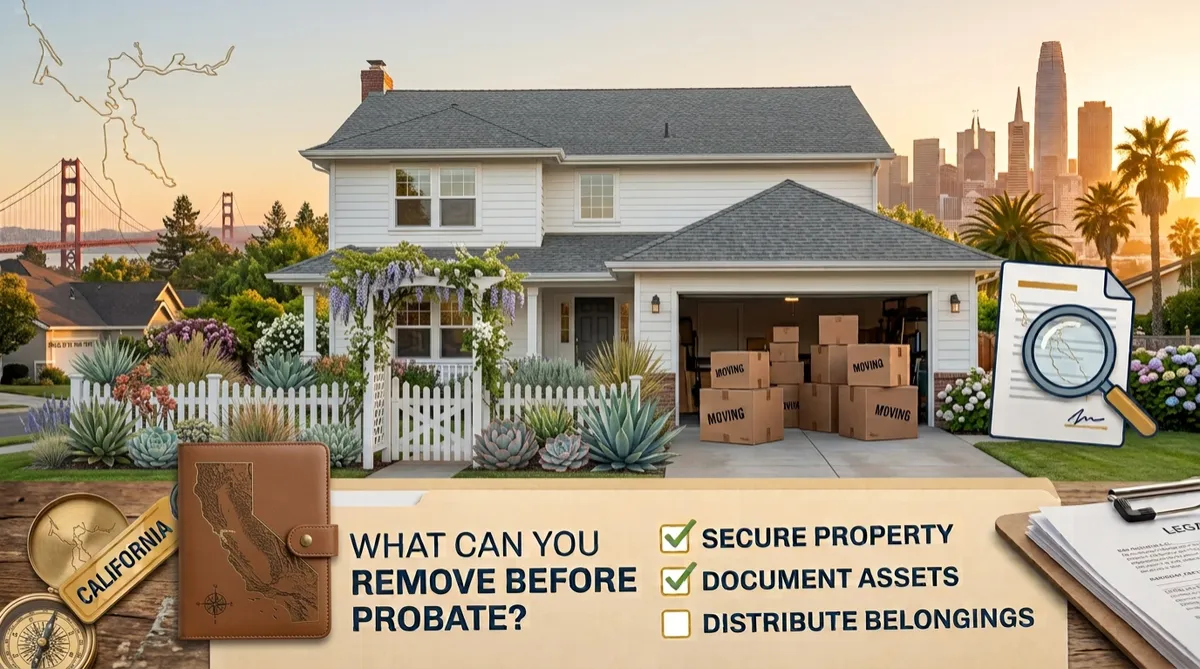
Inherited a Property in California? What Can You Remove Before Probate?
Inherited a Property in California? What Can You Remove Before Probate?
Understanding California probate requirements, protecting estate belongings, and preparing an inherited property for its next chapter.
When someone passes away, the property they leave behind may still be filled with furniture, personal belongings, photographs, important documents, and items that hold significant sentimental or financial value.
Beneficiaries may be eager to begin organizing, cleaning, or preparing the property for sale. But an important question often comes up:
What can legally be removed from an inherited property before probate begins in California?
The answer isn't always straightforward.
While securing and maintaining a property may be appropriate early in the process, selling, donating, or distributing belongings can involve different legal requirements.
At Local Probate Help, we understand that managing an inherited property can feel overwhelming, especially when several beneficiaries are involved or the person responsible for the estate lives out of the area.
Understanding what can be done, what should wait, and who has the legal authority to make decisions can help prevent unnecessary complications.
Can an Inherited Property Be Cleaned Out Before Probate in California?
Possibly, but the answer depends on several important factors:
How the property is legally owned.
Whether formal probate is required.
Who has the legal authority to manage the estate and its belongings.
Whether items belong to the estate or another individual.
Under California Probate Code Section 9650, a court-appointed personal representative generally has the right and responsibility to take possession or control of property that must be administered through probate.
The personal representative also has a responsibility to take reasonable steps to protect and preserve estate assets.
However, this does not mean an inherited property must remain completely untouched until probate is finished.
There is an important difference between protecting a property and distributing estate belongings.
Protecting the property may involve securing doors, checking for maintenance problems, documenting belongings, or addressing an urgent issue that could cause damage.
Distributing belongings involves transferring ownership, selling valuables, donating furniture, or allowing individuals to remove property that may belong to the estate.
These decisions require appropriate authority.
Even if all beneficiaries agree, that agreement does not necessarily replace the legal requirements governing estate property.
Before beginning a major cleanout, it is important to establish who has the authority to act.
What Can Be Done Before Probate Begins?
Although major decisions about estate belongings may need to wait until legal authority is established, beneficiaries can often begin organizing information and identifying issues that need attention.
The key is to avoid making irreversible decisions before confirming that the proposed actions are authorized.
1. Secure and Protect the Property
One of the first priorities should be protecting the property's condition and preventing avoidable damage.
This may involve:
Checking doors, windows, gates, and other entry points.
Identifying water leaks, broken locks, or other urgent concerns.
Maintaining utilities when necessary to protect the property.
Reviewing landscaping and exterior maintenance needs.
Confirming the property's insurance coverage.
Arranging regular property checks if the property is vacant.
A particularly important step is notifying the insurance provider of the property owner's passing and confirming whether the coverage remains appropriate, especially if the property will be vacant.
Insurance companies may have specific requirements for vacant or unoccupied properties.
Any repairs, access changes, or property management arrangements should be coordinated with the person legally authorized to act.
At Local Probate Help, we understand that property protection can become particularly challenging when beneficiaries live outside the area.
Having local real estate expertise and access to reliable professional resources can help identify potential problems before they become expensive issues.
2. Photograph the Property and Its Belongings
Before moving or removing anything, document the property's condition and contents.
Photographs or videos can provide a useful record of what was present before a cleanout or property preparation began.
Consider documenting:
Interior rooms and closets.
Garages, sheds, and storage spaces.
Furniture and household belongings.
Artwork, antiques, and collectibles.
Jewelry and other potentially valuable items.
Visible property damage or maintenance concerns.
If multiple beneficiaries are involved, maintaining an organized record can help reduce confusion about what was originally located at the property.
Photographs may also be helpful when discussing property preparation, identifying items requiring appraisal, or resolving questions about belongings.
Documentation does not establish ownership or replace a formal estate inventory, but it can be an important first step.
3. Locate Important Documents
Inherited properties often contain documents that may be essential to estate administration.
Before discarding paperwork or emptying file cabinets, carefully identify and secure important records.
These may include:
The original will and any trust documents.
Property deeds and mortgage statements.
Insurance policies.
Property tax records.
Bank and investment statements.
Vehicle titles.
Tax returns.
Outstanding bills and financial records.
Other documents relating to assets or liabilities.
California has a specific legal requirement regarding original wills.
Under California Probate Code Section 8200, the person who has custody of an original will generally must deliver it to the clerk of the appropriate California Superior Court within 30 days after learning of the person's death, unless a petition for probate of that will was filed earlier.
The custodian must also provide a copy to the person named as executor, if that person's whereabouts are known, or otherwise to a named beneficiary whose whereabouts are known.
This requirement applies even when the estate may not ultimately require full probate administration.
The original will should be handled carefully and not discarded or altered.
A California probate attorney can help clarify the proper procedures.
4. Prepare a Preliminary Inventory of Belongings
Before a major cleanout, creating a preliminary inventory can be helpful.
This does not require documenting every household item, but belongings with significant financial or sentimental value deserve additional attention.
Consider recording items such as:
Jewelry and watches.
Antiques and artwork.
Collectibles.
Electronics.
Vehicles.
Cash and financial documents.
Family keepsakes and heirlooms.
Identify where these items are located and photograph them when appropriate.
This preliminary record does not replace the formal inventory and appraisal that may be required during probate.
However, it can help beneficiaries and estate representatives understand what needs additional review before items are removed.
What Should Not Be Removed Before Legal Authority Is Established?
One of the most common misunderstandings involving inherited property is assuming that access to the property gives someone the right to remove its contents.
Having a key to the property does not necessarily mean having legal authority over everything inside it.
Even when individuals believe they are entitled to inherit certain belongings, the estate's legal requirements must still be considered.
Selling or Donating Valuable Belongings
Furniture, artwork, jewelry, antiques, and other valuables should not automatically be sold or donated simply because someone expects to inherit them.
A will or other estate planning document may identify specific beneficiaries.
Some belongings may be jointly owned or legally belong to another individual.
Other items may need to be accounted for during estate administration.
Before selling, donating, or transferring valuable belongings, confirm that the person authorizing the transaction has the appropriate legal authority.
Allowing Beneficiaries to Remove Items Without Documentation
Different beneficiaries may have different expectations about personal belongings.
One beneficiary may want certain furniture, while another may be interested in artwork, photographs, or keepsakes.
Even when everyone has good intentions, removing items without documentation can create misunderstandings later.
A practical approach is to maintain a list of requested belongings, document any agreements, and postpone disputed distributions until the appropriate authority has been established.
Discarding Documents or Unidentified Items
Old boxes, filing cabinets, and storage areas may contain information important to estate administration.
Financial statements, insurance documents, original contracts, property records, and other paperwork should be reviewed before disposal.
When there is uncertainty, preserving an item until it can be evaluated is generally the safer approach.
Hiring a Company to Empty the Entire Property
Professional cleanout companies can be valuable resources when preparing an inherited property for sale.
However, hiring a cleanout company does not establish who owns the belongings or who has authority to dispose of them.
Before scheduling a major cleanout, confirm:
Who can legally authorize the work.
Which belongings must be preserved.
Whether valuable items require appraisal or further review.
Whether any items are disputed.
How removed belongings will be documented.
Whether estate funds are available and may properly be used for the work.
At Local Probate Help, we recognize that preparing an inherited property often involves more than simply removing belongings.
Our property-related resources can help estate representatives coordinate cleanout services, evaluate preparation needs, and develop an appropriate plan once the necessary authority has been confirmed.
What If You Are the Executor Named in the Will?
Being named as executor can come with significant responsibilities.
However, being named in a will does not automatically give someone the legal authority of a court-appointed personal representative.
When formal probate administration is required, the person named as executor generally must be appointed by the Probate Division of the California Superior Court.
The court then issues the appropriate letters establishing that person's authority.
If there is no will, or the named executor cannot serve, the court may appoint an administrator.
The executor or administrator appointed by the court is generally referred to as the estate's personal representative.
Before that appointment, someone named in a will should avoid assuming they have authority to sell estate assets, distribute belongings, or enter into significant contracts on behalf of the estate.
Appropriate preliminary steps may include locating documents, identifying urgent property concerns, and consulting an attorney.
If immediate action is necessary to protect estate assets before a general personal representative can be appointed, a California probate attorney can evaluate whether a special administrator or other appropriate legal procedure is available.
What If the Property Is Held in a Trust or Jointly Owned?
Not every inherited property requires a traditional probate administration.
The way the property was legally owned can make a significant difference.
Property held in a living trust
If the property was properly transferred into a living trust, a successor trustee may have authority to administer it according to the trust's terms and applicable California law.
Certain jointly owned properties
Real estate held in certain forms of joint ownership, such as joint tenancy with a right of survivorship, may transfer outside formal probate, subject to the appropriate legal procedures.
Properties eligible for simplified transfer procedures
California provides certain simplified procedures for qualifying estates and inherited real property.
Eligibility depends on factors such as the date of death, property value, ownership, and other statutory requirements.
However, it is important to remember that ownership of the real estate and ownership of the personal belongings inside it are not necessarily the same.
Even when the real estate transfers outside probate, the personal belongings may still require separate consideration.
A California probate attorney can help determine which legal procedures apply.
Does an Inherited Property Need to Be Completely Emptied Before Selling?
Not necessarily.
This is an important consideration because beneficiaries sometimes assume they must remove everything, complete repairs, and prepare the property before exploring a sale.
That is not always the most practical or financially beneficial approach.
At Local Probate Help, we help beneficiaries evaluate potential selling strategies.
Every estate is different, and the right approach should be based on the property's circumstances rather than assuming every inherited property must be fully cleared before selling.
A Helpful Checklist Before Clearing an Inherited Property
When managing an inherited property, consider these important steps before beginning a major cleanout.
Confirm who has legal authority. Determine whether a court-appointed personal representative, successor trustee, surviving owner, or another legally authorized party can make decisions.
Secure the property. Identify urgent maintenance, safety, or security concerns.
Review insurance coverage. Notify the insurer of the property owner's passing and confirm any vacancy-related requirements.
Document the property's condition. Photograph rooms, storage spaces, and visible belongings.
Locate important records. Preserve original estate planning documents, deeds, insurance policies, and financial information.
Identify potentially valuable belongings. Prepare a preliminary inventory of items that may require appraisal or special attention.
Avoid premature distributions. Do not sell, donate, or distribute disputed estate belongings without appropriate authority.
Understand the property's market value. Obtain a professional real estate evaluation before deciding how much preparation makes financial sense.
Compare selling strategies. Evaluate As-Is, As-Is Plus, and Traditional Sale options.
Coordinate professional resources. Work with the appropriate attorney and local real estate professionals before authorizing a major cleanout or sale.
At Local Probate Help, we recognize that managing these responsibilities can involve numerous moving parts. Our approach focuses on providing practical property-related guidance, access to professional resources, and personalized support to help beneficiaries move forward one step at a time.
Frequently Asked Questions
Can clothing and ordinary household belongings be discarded before probate?
Not automatically. Even items with limited monetary value may have sentimental significance or belong to the estate. Confirm who has authority to approve disposal before removing belongings.
Can jewelry, cash, or other valuables be removed from the property?
Valuable belongings should not be removed or distributed without appropriate authority. If items are at risk of theft or loss, document the circumstances and consult the authorized estate representative or a qualified California probate attorney about protecting them.
Can the property be cleaned out if all beneficiaries agree?
Agreement among beneficiaries can make the process easier, but it does not necessarily replace legal authority or resolve questions about ownership. Confirm that the proposed cleanout is legally permitted before proceeding.
Can a professional cleanout company be hired before probate is completed?
Potentially, yes. Some cleaning and property preparation activities may be appropriate before probate is completed. However, the work must be authorized by someone with the legal authority to act, and potentially valuable or disputed belongings should be addressed appropriately.
Can you secure or maintain an inherited property before probate is completed?
No. Securing, documenting, and maintaining the property may be appropriate before probate is finished. The important distinction is whether the proposed action is permitted and whether the person authorizing it has the necessary authority.
What if beneficiaries disagree about personal belongings?
Disagreements may involve sentimental items, financial value, or questions about who is legally entitled to receive certain property. Document the concerns, avoid distributing disputed items, and consult a qualified California probate attorney when necessary.
What if someone has already removed belongings from the property?
The appropriate response depends on who owns the items, whether the removal was authorized, and the circumstances involved. Keep an accurate record of what occurred and seek legal guidance if there is a dispute involving estate property.
Can a property be sold without removing all the belongings?
Sometimes. Depending on the property's circumstances and the buyer's agreement, a property may be sold in its present condition with certain contents remaining. However, the authorized estate representative must address ownership and determine what belongings may legally be included in the transaction.
Before Making Decisions, Understand Your Options
Managing an inherited property involves more than determining what to keep and what to remove.
There may be important legal requirements, maintenance concerns, financial obligations, and decisions about the property's future.
While it is natural to want to begin organizing and clearing the property, the first step should be understanding what can legally be done and who has authority to make those decisions.
Taking time to document belongings, protect the property, and identify the appropriate professional resources can help avoid unnecessary complications.
At Local Probate Help, we understand that inherited properties often come with unique challenges, especially when beneficiaries live out of the area, multiple parties are involved, or the property needs significant attention.
We help beneficiaries, executors, administrators, and trustees throughout the San Francisco Bay Area and beyond navigate the real estate side of the process.
From evaluating property values and comparing selling strategies to coordinating cleanout resources, property preparation, and other services, our goal is to help simplify the process and provide practical guidance every step of the way.
An inherited property deserves a thoughtful strategy, not rushed decisions.
Have Questions About Clearing or Selling an Inherited Property?
You don't have to navigate the process alone.
At Local Probate Help, we're here to listen, answer your property-related questions, and help you explore your options with care and understanding.
Every situation is unique, and sometimes a simple conversation with a probate real estate expert is the best place to start.
For a confidential, no-obligation conversation, call 925-858-9358. We'd be happy to help.
Legal disclaimer: This article is intended for general educational purposes and does not constitute legal, tax, insurance, or financial advice. California probate requirements depend on property ownership, estate planning documents, applicable laws, and individual circumstances. Consult a qualified California probate attorney regarding legal authority, estate administration, and the disposition of estate belongings.